Renewable energy lawyer delivers "".
Article posted in 2024-09-10 10:53:03 | VEAT
Recently, the enactment of the 「Distributed Energy Activation Special Act」 (abbreviated as the Distributed Energy Act) is expected to drastically expand the nationwide adoption of renewable energy. In this post, we will thoroughly examine the definition of the Renewable Energy Act, the main contents of the 「Distributed Energy Activation Special Act」, and its expected effects.
Definition of the Renewable Energy Act and Advantages of Renewable Energy
The formal name of the law commonly referred to as the 「Renewable Energy Act」 is the 「Act on the Promotion of Development, Utilization, and Distribution of New and Renewable Energy.」 According to the definition of the 「Renewable Energy Act」, hydrogen energy and fuel cells are included in new energy, and solar and wind power belong to renewable energy. New energy and renewable energy share a commonality in that they produce significantly less or no pollutants and carbon emissions compared to existing fossil fuels. This is a very important element for environmental protection and sustainable development.
Renewable energy generation also has the advantage of not requiring fuel costs because it utilizes natural forces. The government has recently announced a strategy to expand renewable energy adoption and strengthen supply chains to expand renewable energy generation. The goal of this strategy is to distribute 6GW of renewable energy generation facilities annually by 2030. However, the adoption record of renewable energy over the past 23 years has been around 34GW per year, which falls short of the goal.
What factors hinder the adoption of renewable energy? The lack of transmission and distribution infrastructure is one reason why renewable energy generation is progressing slower than the target. In our country, a large-scale centralized power plant system requires the construction of a large transmission and distribution infrastructure to send electricity to demand locations far away. This leads to problems such as various complaints and environmental issues surrounding the construction of transmission lines, as well as significant social and economic costs, causing delays in site selection and construction.
The government and Korea Electric Power are continuously working to expand transmission and distribution infrastructure, but because expanding social infrastructure requires a long time and cost, it is difficult to resolve the shortage of transmission and distribution infrastructure in the short term.
Definition and Role of the 「Distributed Energy Activation Special Act」
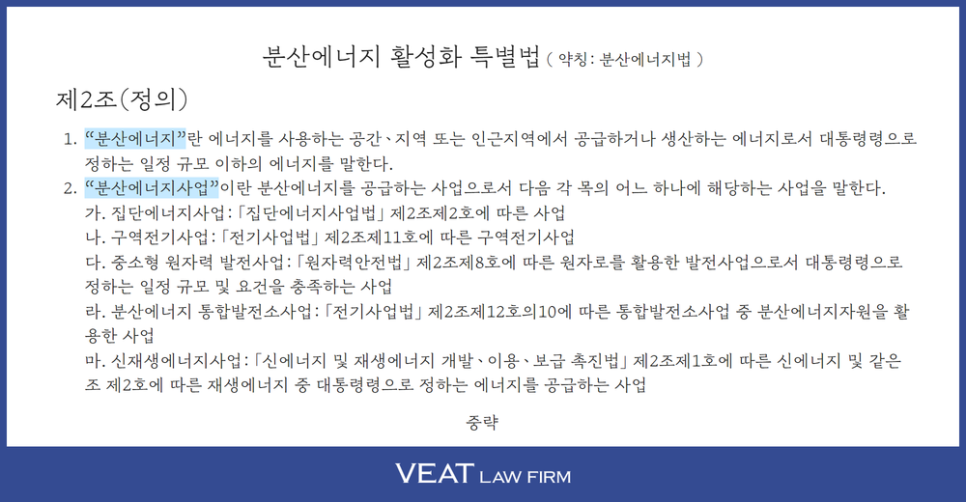
The Distributed Energy Act was enacted in June 2023 and came into effect on June 14, 2024, and was enacted to activate energy production and consumption within regions. This law, which is expected to be a major breakthrough for the stalled domestic renewable energy adoption record due to a lack of transmission and distribution infrastructure, aims to establish a system in which power consumers near energy production sites produce, supply, and consume energy through new energy power plants, energy storage systems (ESS), demand response resources (DR), and private power generation. The existing large-scale power generation system produces electricity centrally and sends it to each region through transmission and distribution facilities. This system has problems such as low public acceptance, regional supply-demand imbalances, and energy loss during the supply process, as well as the cost of constructing and maintaining transmission and distribution facilities. Distributed energy systems have emerged as a solution to these problems. A distributed energy system refers to a regional energy system that produces energy needed in each region. Through this system, each region can independently produce and consume energy, supplementing the shortcomings of a centralized system.
Expected Effects of the Implementation of the Distributed Energy Act
The following expected effects are expected with the implementation of the Distributed Energy Act:
- Reduced power loss: Energy loss can be minimized by reducing long-distance transmission and distribution processes.
- Reduced social conflict: Complaints and environmental issues surrounding the construction of transmission lines can be reduced.
- Improved energy independence: Local governments and residents can reduce electricity bills through high energy independence.
- Expanded opportunities for industry: Opportunities for businesses related to flexibility resources such as energy storage systems (ESS), demand response resources (DR), and virtual power plants (VPP) will be expanded along with renewable energy generation.
- Achieving carbon neutrality: The active use of new energy resources such as solar, wind, fuel cells, biogas, and hydrogen will contribute to achieving carbon neutrality goals.
- Alignment with RE100 Initiative: It lays the groundwork for companies to expand the use of renewable energy.
The Distributed Energy Act aims to establish a system in which power consumers near energy production sites produce, supply, and consume energy through new energy power plants, energy storage systems (ESS), and demand response resources (DR). If these distributed energy sources are built near consumers and supply power, the construction of additional renewable energy power plants can be accelerated without constructing long-distance transmission lines. The government’s conciliatory policy to prevent initial confusion in the implementation of the law is understandable, but we hope that the scope and targets of the law will be expanded to be in line with its original intent.
Improvements to the Enforcement Decree and Regulations of Distributed Energy
However, there are also some shortcomings in the Enforcement Decree and Regulations of the Distributed Energy Act. It is necessary to improve the exclusion of industrial park managers and advanced medical complex managers from the mandatory installation entities, and the setting of regional ratios for the mandatory installation volume, setting 100% for the Seoul Metropolitan Area and 0% for other regions.
Renewable Energy PF Legal Advisory
Veat Law provides legal advice based on a deep understanding of relevant laws, including the Renewable Energy Act and the Distributed Energy Act. In particular, Partner Attorney Kyoung-soo Ko provides professional legal services in ESG areas, drawing on his extensive experience in various energy and environmental industry projects. Attorney Ko has successfully led numerous projects, including setting up and operating a private equity fund for renewable energy development, investing equity in a 60MW tidal land solar power generation project, and setting up and operating a private equity fund investing in the recycling and resource utilization of waste. He also lectures on renewable energy technology and utilization and waste resource energy conversion processes as an adjunct professor at the Smart EID College of Engineering at Chungbuk National University, actively engaged in various fields.
Veat Law, led by Attorney Kyoung-soo Ko, will continue to provide innovative and sustainable legal solutions in the renewable energy and environmental industries. If you need legal advice related to the Renewable Energy Act, the Distributed Energy Act, and the environmental industry, please feel free to contact Veat Law. (Contact us)
Thank you.
Veat Law Team