[IT Lawsuits] Check! From the meaning of Crawling to Legal Risks. Possibility of Violations of Copyright Law and Unfair Competition Prevention Law.
Article posted in 2025-02-12 18:12:16 | VEAT
▶What is Crawling?
Crawling is a technology for automatically collecting information existing on websites, and is also used by search engines when indexing websites. However, recently, there has been an increase in cases where companies crawl and utilize data from competitors or specific platforms, which has also led to an increase in legal disputes.
In particular, unauthorized crawling may be interpreted as a violation of the 「Copyright Act」 and 「Act on Prevention of Unfair Competition and Protection of Business Secrets」 (hereinafter referred to as the “Unfair Competition Prevention Act”), which may result in criminal punishment or liability for damages. Therefore, it is essential to receive legal review regarding the possibility of violation of the Copyright Act or the Unfair Competition Prevention Act before utilizing information from another website by crawling it.
▶Possibility of Violation of the Copyright Act
The Copyright Act prohibits unauthorized copying, distribution, and modification of copyrighted works, and databases can also be subject to protection.
The Supreme Court has stated that in order to determine that the right of the database creator has been infringed, it must be the case that the data has been copied or substantially reproduced without the permission of the database creator. When determining whether the copying constitutes a substantial portion, both quantitative and qualitative aspects must be considered. The quantitative aspect is determined by comparing the copied portion to the size of the entire database, while the qualitative aspect is determined by considering whether the database creator has invested substantial human or material resources in the production of the individual materials contained in the copied portion, or in the updating, verification, or supplementation of those materials. (Supreme Court Decision 2022. 5. 12. in Case No. 2021do1533).
That is, if a specific website provides data with a significant scale and substantial human and material investment has been made in that data, utilizing it through crawling may be recognized as a violation of the Copyright Act.
▶Possibility of Violation of the Unfair Competition Prevention Act
Paragraph 1, Sub-paragraph (d), Article 2 of the Unfair Competition Prevention Act deems the act of using achievements created through substantial investment or effort without authorization as an act of unfair competition.
The High Court of Seoul has stated that in order to determine that something constitutes achievements created through substantial investment or effort, it must be evaluated as not belonging to the so-called public domain where anyone can freely utilize it (High Court of Seoul Decision 2022. 8. 25. in Case No. 2021na2034740). That is, if the data provided by a specific website is evaluated as having been created through substantial investment or effort to the extent that it does not belong to the public domain, the act of utilizing that data through crawling may violate the Unfair Competition Prevention Act.
▶Legal Criteria for Judging Crawling
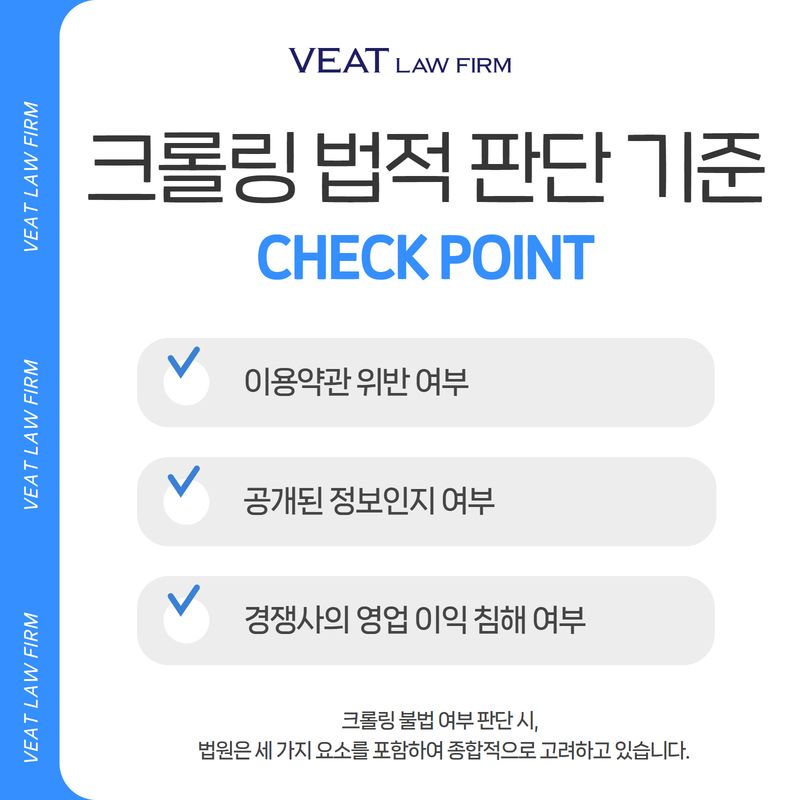
The court comprehensively considers the following elements when determining whether crawling is illegal.
1. Violation of Terms of Use
- Many websites prohibit crawling through their terms of use, and violation of these terms may result in legal issues.
2. Whether Information is Publicly Available
- The legality varies depending on whether the information is accessible without logging in, or whether it is provided only to specific users.
3. Whether it Infringes on a Competitor’s Business Interests
- There is a high probability of legal dispute if the crawled information is a competitor’s core asset, and unauthorized utilization thereof causes economic loss to the other party.
▶Mandatory Legal Review Before Utilizing Crawling Law firm Veat specializes in legal consultation for IT, data, and information technology, and has extensive experience in various legal issues related to crawling. In particular, Veat collaborates with various startups, IT companies, and data-driven platforms to support the legal utilization of data through crawling. If you need legal consultation regarding IT and software-related matters, please feel free to contact Law firm Veat.
▶Legal Consultation Related to Crawling by Law firm Veat
- Crawling Legality Review: Prior review to determine whether a specific crawling method violates the Copyright Act, Unfair Competition Prevention Act, and Terms of Use
- Data Utilization Consulting: Providing legal consultation on how to legally process and utilize crawled data
- Crawling Dispute Response and Litigation Support: Establishing a legal response strategy for the company and litigating in the event of a crawling-related legal dispute.