[IT Litigation] Key Points of Software Service Contracts, How Far Does ‘Completion’ Go?
Article posted in 2025-04-22 14:52:25 | VEAT
Digital transformation is accelerating, and companies are entering into various software service contracts for self-system development, app construction, and the introduction of automation tools. However, as these technology-based contracts increase, so does the reality of legal disputes between the parties involved. The core of disputes in software service contracts is whether “the service has been fully performed and the task is completed”. That is, it occurs when there is a difference in opinion between the developer (or contractor) who claims that software development and construction has been completed, and the client (or principal) who sees it as still incomplete.
The key element determining whether a dispute is resolved is the ‘acceptance criteria’. Even if the scope of work is specified in detail in the contract, the absence of clear criteria for determining whether the work has been completed can only lead to difficulty in preventing disputes in advance or resolving them afterward. In particular, when the result is software, like an intangible result, it is difficult to physically confirm the performance, and the concept of ‘completion’ itself can become unclear, making the setting of acceptance criteria even more important.
Acceptance criteria should be set from the beginning of a software service contract.
When entering into a software service contract, many companies or startups focus on functional requirements or development schedules, but often neglect the important ‘completion’ criteria, that is, the acceptance procedure and judgment criteria. However, in reality, legal disputes most frequently arise from the absence or ambiguity of acceptance criteria.
Before a contract is concluded, the client and the contractor must specifically agree on what state they will consider ‘completion’ and include that content in the contract. For example, the following items should be clearly defined.
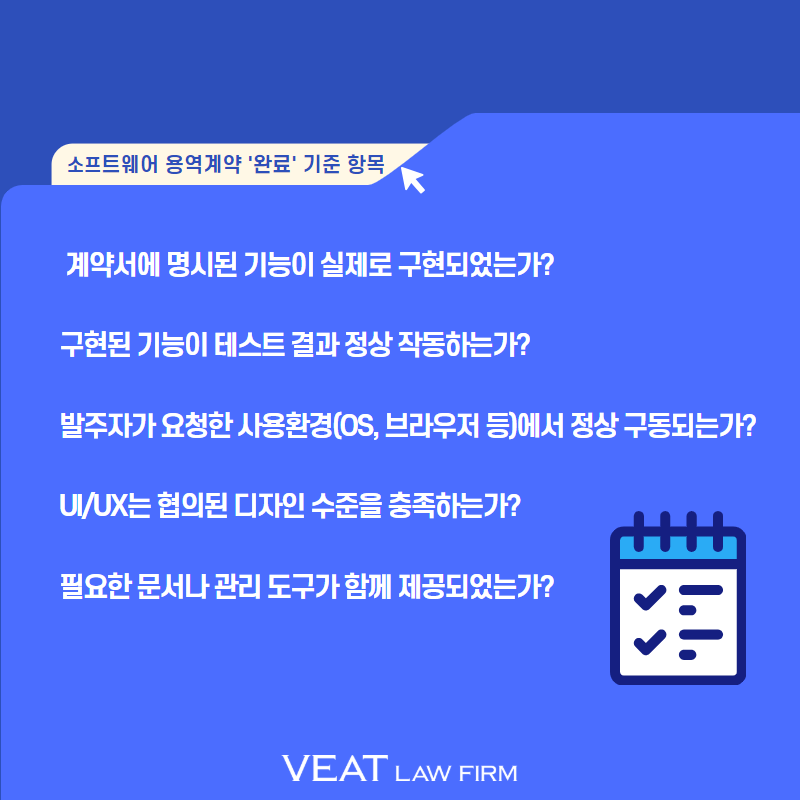
If acceptance items that objectify the completion criteria are not specified in the contract, the client may reserve acceptance and delay payment of the final payment, and the contractor may claim that it is a breach of contract or unjust non-payment of the final payment, leading to conflict. In reality, there are many cases where such matters proceed to litigation.
Ultimately, the concept of ‘completion’ should not be interpreted by either party based on verbal agreements or conventions, but should be specifically defined in the contract as the most effective measure to prevent disputes. Even to prevent unnecessary differences in interpretation surrounding whether a project has been terminated, acceptance criteria must be a mandatory item to be set from the draft contract stage.
Software service contract acceptance criteria components


Acceptance procedure and deadline
Specific details should be defined, such as the start date of acceptance, the acceptance criteria, and the deadlines.
Law firm Veit has experience collaborating with numerous software developers and IT startups and providing legal advice on IT projects, startup platform development contracts, and public agency system construction service contracts. Providing professional legal advice based on the experience. To make the contract not just a ‘signed document’ but as a shield to protect our technology assets, legal advice is essential. When you need legal advice or review of software contracts, please feel free to contact law firm Veit.
Thank you.
Law firm Veit