“Wait! Did you receive marketing opt-in consent before sending the advertisement message?”
Article posted in 2022-02-22 10:37:13 | VEAT
Law firm Veat provided legal advice regarding whether to include advertising when sending newsletters on behalf of Company A, in response to a request to send a newsletter that transmits various contents to applicants, containing a strong>determination of whether to obtain the consent for marketing recipient information if the newsletter is sent with advertising included.
According to the “Information and Communications Network Act” (hereinafter “Information Network Act”), a business operator must obtain prior consent to send commercial advertising information via electronic transmission media. Even if the main information is not advertising, if it is a supplementary case, consent is still required unless it falls within an exception, and even if a financial reward is paid for a transaction involving goods sent in relation to a pre-existing business relationship.
The Personal Information Protection Committee stipulates that ‘explicit consent’ should be obtained for marketing recipient consent, therefore, it is not desirable to consider a method in which consent is deemed to have been obtained if there is no objection after sending an email.
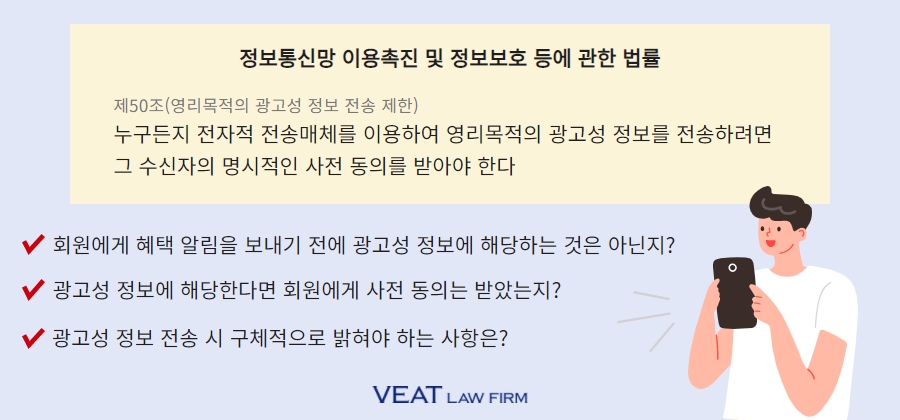
In addition to this, many companies are sending various informative messages for marketing purposes, but unless it falls under a specific exception, such as informative messages or notifications for providing benefits to members, it is not permissible to send information without the member’s explicit consent.
In particular, in the case of coupons, mileage, or other benefits provided by a business operator, which include promotional purposes to encourage the use of the corresponding products and services, these coupons and mileages are, as a rule, considered commercial information. However, the Information Network Act stipulates that anyone must obtain the explicit prior consent of the recipient to transmit commercial information via electronic transmission media. Due to this, commercial information transmissions are, as a rule, restricted. Even free newsletters or event notifications that may be helpful to members may be an exception, so companies need to verify whether they have obtained the member’s explicit consent before sending commercial information.
If a member does not wish to receive benefit or advertising information notifications, but receives such information without explicit consent, there is a risk of a penalty for violating the Information Network Act, which can also cause inconvenience for many members.
Therefore, before sending benefit notifications to members, it is necessary to consult a lawyer regarding whether the information is considered commercial information, whether explicit consent has been obtained if it is commercial information, and what specific matters must be disclosed when transmitting commercial information.
Thank you.
Law firm Veat.